 Simplified Startup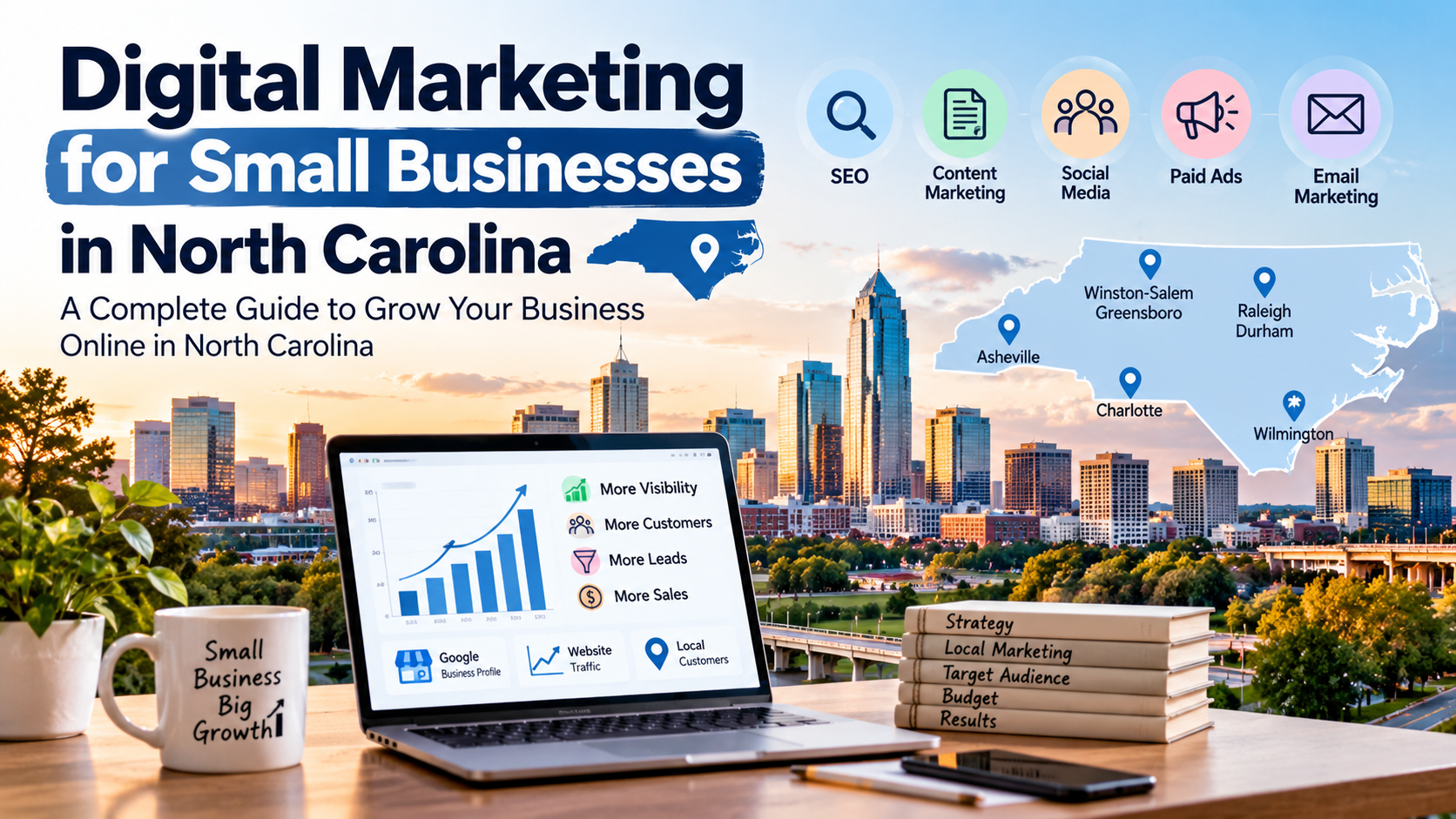
There are about 1.1 million small enterprises in North Carolina. They employ roughly 1.8 million people, or nearly 44% of the workforce, and comprise 99.6% of all businesses in the state. 172,000 new companies were registered here in 2025 alone — the second-highest number ever.
There is fierce rivalry for the same clients, and the majority of it takes place online before anyone answers the phone.
This article especially addresses digital marketing for small business owners in North Carolina, including how much it costs, which channels are effective in different regions of the state, and how to geotarget a market that spans from a banking center to a barrier island.
The True Meaning of Digital Marketing in This Context
Digital marketing for small business is using online platforms to attract customers who are already searching for your products. Search, email, content, social media, paid advertisements, your website, and your Google Business Profile.
The fascinating thing is not the list. What counts is that depending on where you are in North Carolina, one of those channels may or may not be profitable. Small businesses include a boutique hotel in Asheville and a plumber in Cary. They shouldn't be using the same strategy.
The Real Look of the North Carolina Market
There are multiple markets in North Carolina. They act differently, and there are at least five of them.
The Research Triangle (Raleigh, Durham, Chapel Hill)
Wake, Durham, Orange, and Johnston counties are home to about 2.4 million people. University spending, life sciences, technology, and pharmaceuticals. The audience is well-informed and reads before making a purchase.
What works here: long-form material, comparison pages, extensive service pages. Before making a call, people in the Triangle will read 1,500 words. Because agencies and SaaS companies bid on the same terms, paid search is costly.
Mecklenburg County and Charlotte
About 2.9 million inhabitants, the 21st largest metro in the country and the second-largest banking center in the US. Finance, insurance, logistics, and professional services.
What works here: LinkedIn for B2B, Google Search for local services, and strict geotargeting. Charlotte is dispersed. A citywide radius wastes the majority of your budget because no one in Ballantyne drives to Huntersville for dental care.
The Triad: High Point, Winston-Salem, and Greensboro
Furniture, manufacturing, logistics, and medical care. Forsyth and Guilford counties. There is less competition and significantly lower costs per click than in Charlotte or Raleigh.
What works here: genuine visibility can be obtained with a small budget. You are typically not under the same bid pressure if you serve the Triad.
Wilmington and the Coast
New Hanover, Brunswick and Pender counties. Tourism, film, marine services, healthcare, and heavy seasonal swing. Retirees and second-home owners are a real segment.
What works here: seasonality planning. Spending the same amount in January and June makes little sense on the shore. Shift budget to the shoulder seasons, when people are researching.
Western North Carolina and Asheville
The mountains and Buncombe County. Breweries, tourism, hospitality, the arts, and outdoor activities. Some areas are still rebuilding following Helene, which altered local search habits and the questions tourists ask before departing.
What works here: visual content, Instagram, Google Business Profile images, and up-to-date, unambiguous information about what is open and functioning.
The Cost of Digital Marketing in North Carolina
Since no North Carolina rate cards are published, instead of quoting unverifiable figures, here is the arithmetic behind them.
Start with click costs. The 2026 cross-industry Google Ads average is $5.42. Legal is the priciest vertical at $9.87, home improvement around $8.33. Within the state, Charlotte and Raleigh bid above those averages and the Triad, Fayetteville and smaller markets below.
Now apply a conversion rate. Local service search traffic converts at roughly 5 to 8%, which gives you a cost per lead:
Fayetteville, Triad, and smaller markets. About $70 per lead, or $4 to $6 per click at a 7% conversion rate.
Wilmington, Asheville, Winston-Salem. About $5 to $8 a click at 7%, so roughly $95 a lead.
Charlotte and Raleigh-Durham. $7 to $11 per click at 6%, or about $140 each lead.
Legal and other high-value services in those two metro areas. $12 to $18 a click at 5%, so $300 a lead or more.
Your budget is determined by those cost-per-lead numbers. Work backwards from the leads you need. In Greensboro, fifteen leads per month equates to roughly $1,050 in advertising expenditures. Just because of where you are, the same fifteen in Charlotte costs roughly $2,100 — the same campaign, the same industry, but twice as much.
So the working brackets:
Single location, smaller North Carolina market. $1,000 to $1,800 a month total. Around $1,000 into ads, the rest into Google Business Profile development and content.
Single location, Charlotte or Raleigh metro. $2,000 to $3,500 in total each month. Around $2,000 into ads for a similar lead count, the rest into local SEO.
Multi-county or multi-location. $4,000 to $7,000 each month. Separate landing sites, campaigns and Google Business Profiles per area.
Legal, medical or other high-value services in a big metro. $5,000 and more, as a $300 lead leaves no space for a lower amount.
One correction worth making, because it is commonly repeated and false. There is a minimum advertising budget of about $1,000 or $1,500, people will tell you. The actual threshold is a conversion count rather than a monetary amount. Google's smart bidding needs around 30 conversions a month to learn properly: about $2,100 a month in ads in a Triad area, closer to $4,200 in Charlotte. Below that you are better off on manual CPC with a tight keyword list than having an algorithm learn on 10 data points.
Agency costs fall on top of all of this, generally $800 to $2,500 a month. A $3,000 budget can easily translate into just $1,800 actually reaching customers.
Put everything in your Google Business Profile and nothing in ads if none of these figures are yet affordable. It costs nothing, and for most local North Carolina businesses it creates more than an underfunded ad account ever would.
Local SEO for Companies in North Carolina
This is the area where most small businesses do poorly and where a North Carolina digital marketing plan generates the majority of its return.
Google Business Profile
Complete every field. Correct primary category. Real images, not stock. Each service is listed separately. Hours kept precise, including seasonal fluctuations on the coast and in the mountains. Post at least twice a month.
Build pages for genuine service areas, not the whole state
The "Services in North Carolina" page is worthless. Pages for Cary, Apex, Morrisville and Holly Springs, each having really separate content, can rank for all four.
The content has to be different: different projects, photos, local details. Google recognizes four pages with the city name changed as a doorway page pattern.
North Carolina citation sources worth having
Your local chamber. Member directories with significant weight are maintained by Asheville, Durham, Greensboro, Wilmington, and Charlotte. Membership varies, around $450 upward depending on chamber and business size.
Beyond that: the NC Secretary of State registry, county and city directories, the Better Business Bureau of Southern Piedmont or Coastal Carolina depending on your region, industry associations, and local tourism boards if you are visitor-facing. Keep name, address and phone identical everywhere.
Reviews
In competitive North Carolina metros, review volume and recency move rankings. A steady trickle is preferable to a burst. Three days following the job, text each client with a direct link.
Create a Website That Converts North Carolina Traffic
Your website should make six things evident within seconds: what you offer, who you serve, where you operate, why you, how to find you, and what to do next. Two things matter more here than most owners expect.
State your service area in plain text. Not only on a map embed, which is difficult for search engines to read. Write the counties and cities out.
Mobile load speed. There is unequal coverage in North Carolina's rural areas. On a county road, a website that loads in two seconds on office wifi might take eight, and the visitor is gone.
Content That Works in a North Carolina Market
The most valuable content you can publish is the content a national competitor cannot.
Local regulation and process. What permits a deck needs in Wake County. What a Mecklenburg County business license involves. What New Hanover County's flood zone classification means for insurance. Searched constantly, answered badly.
Local seasonality. Hurricane preparation on the shore. The Piedmont has a harsh and predictable pollen season. Winter pipe protection in the mountains.
Your prices. AI summaries will not quote your rates. One of the few things that consistently generates a click is publishing them.
A landscaping business in Raleigh writing about Bermuda grass in Piedmont clay is doing something no generic lawn care site can equal.
Paid Advertising: Strictly Geotarget
Targeting too broadly is the most prevalent waste in North Carolina ad accounts.
Aim for a county or ZIP code rather than a state. Go after Wake County if you work there. Adding Durham because it is nearby doubles your expense and halves your relevance.
Use radius targeting in the vicinity of your service area. A 10-mile radius typically works better for Charlotte than the entire metro.
Exclude what you cannot serve. If you won't cross the Cape Fear River for a job, exclude Brunswick County from your targeting.
Direct visitors to the appropriate page. Ads for emergency plumbing should land on an emergency plumbing page for that city, not the homepage.
Set up call tracking. For most North Carolina local businesses the conversion is a phone call, not a form fill, and untracked calls make working campaigns look like failures.
Measure What Is Actually Working
Spend, inquiries, closed customers, cost per lead, cost per customer, and revenue attributed are all tracked on a monthly basis. Track quarterly: revenue by channel, repeat customer percentage, email list growth.
Ask every inquiry how they discovered you. Analytics under-reports word of mouth, signage and anything with several touchpoints before the click, and word of mouth is still enormous in smaller North Carolina communities.
Be impatient with ads and patient with SEO. Paid campaigns show signal in three to four weeks. Local SEO in a Triad market may move in three months; in Charlotte or Raleigh, expect six to nine.
A Practical Plan to Start
Step 1. Clearly define your service area. Counties and cities, written down.
Step 2. Complete your Google Business Profile after claiming it. Photos, categories, services, hours.
Step 3. Fix the webpage essentials. Mobile speed, visible phone number, service area in text, one clear action per page.
Step 4. Build pages for your top three service areas, with genuinely different content on each.
Step 5. Create a review request that is sent out automatically following each job.
Step 6. Add citations. Chamber, BBB, Secretary of State, and trade groups.
Step 7. Start paid marketing only when you can fund about 30 conversions a month, roughly $2,100 in the Triad or $4,200 in Charlotte. Below that, run manual CPC on a tight keyword list. Geotarget by county.
Step 8. Review monthly. Cost per lead, lead to customer rate, cost per customer.
Concluding Remarks
Effective online marketing for small business here does not mean doing everything. It involves recognizing which North Carolina market you are in, what a consumer is worth to you, and which two channels you can execute well.
A business in Greensboro and one in Charlotte need different budgets and different expectations in the same industry. A small business marketing plan that ignores that will overspend in one place and underspend in the other.
Make sure your service area pages are correct, start with your Google Business Profile, and then consider advertisements.
Frequently Asked Questions
What does small business digital marketing entail?
Digital marketing for small business implies using online channels, including search engines, your website, Google Business Profile, email, content and paid advertising, to attract potential customers and produce inquiries or sales.
How much should a small business in North Carolina invest in digital marketing?
It depends on your market. A single-location business needs about $1,000 to $1,800 per month in a smaller area and $2,000 to $3,500 in a major metro because the cost per lead for the same service is about $70 in the Triad and $140 in Charlotte or Raleigh. Multi-location firms often need $4,000 to $7,000. Agency fees sit on top of ad spend.
Which digital marketing approach works best for small businesses?
There isn't just one solution. The proper digital marketing strategy relies on your location, industry, competition and budget. A thorough Google Business Profile, service area pages, and a methodical review procedure are the top priorities for the majority of local North Carolina firms.
How might local SEO benefit a North Carolina business?
When someone searches for your service in your region, local SEO helps you show up. It includes location-specific pages, citations in North Carolina directories and chambers, Google Business Profile optimization, reviews, and uniform business information across all platforms.
How long does it take for SEO to be effective in North Carolina?
In less competitive markets like the Triad or Fayetteville, local SEO can show movement in approximately three months. Six to nine months is more reasonable in Charlotte and the Research Triangle, where competition is fiercer.
In terms of digital marketing, which North Carolina cities are the most competitive?
Raleigh-Durham and Charlotte have the highest click prices and are the most competitive. A minimal budget goes a long way because Greensboro, Winston-Salem, Fayetteville, and other smaller markets are less crowded.
Is online marketing useful for small businesses?
Yes, and typically at a lesser cost than traditional advertising, online marketing for small business helps companies get found, establish trust, create leads, and maintain contact with current consumers.